Lecture 10.1
Welfare States in the OECD
Emmanuel Teitelbaum
Overview
What is the OECD?
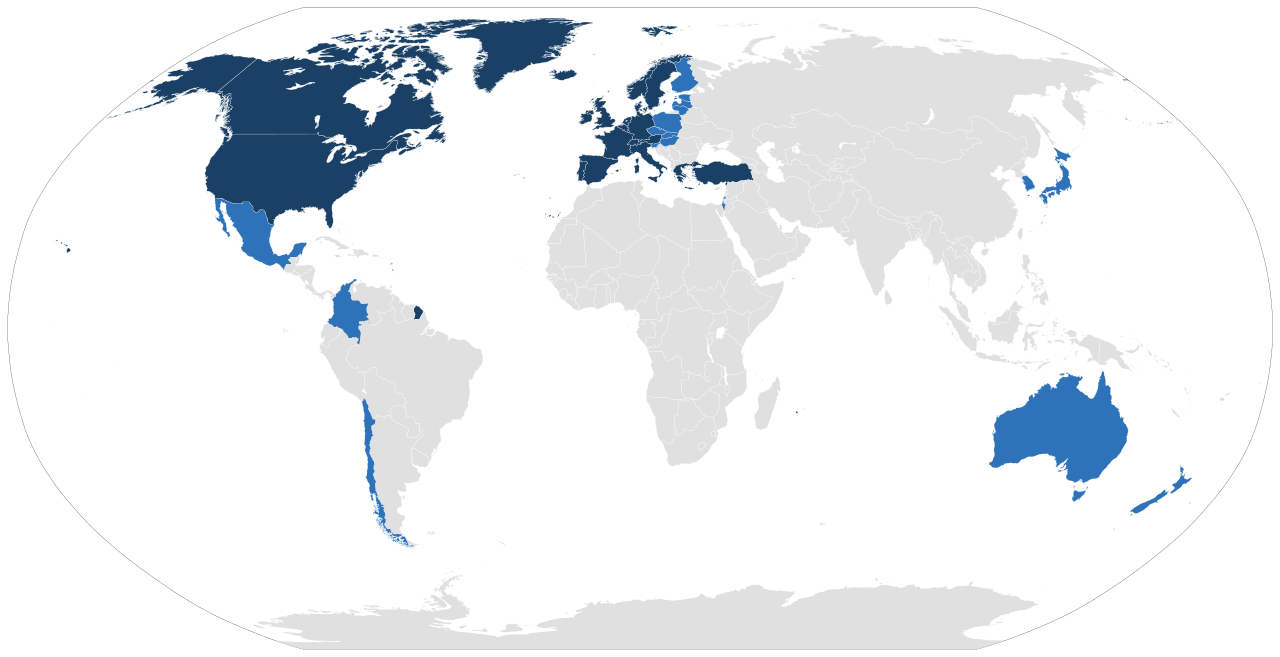
Source: Wikipedia
Key Questions
- What is the welfare state and how does it vary?
- “Three worlds” of welfare capitalism
- Reasons for three worlds
- Gender and the welfare state
- How do welfare regimes affect women?
- Why are some more supportive than others?
- Globalization and the three worlds
- Will they endure?
- How Do We Get to Denmark?
Three Worlds of Welfare Capitalism
Definitions and Concepts
- Welfare state–system of public benefits and services that address human welfare needs
- Cash benefits
- Services
- Social rights—rights to the provision of basic services like education, health care, and a basic standard of living
- De-commodification—state in which a person is not dependent on selling her labor power in the market to ensure her survival
- Universalism —the degree to which everyone has an equal right to publicly provided benefits and services
Welfare State Regimes (“Three Worlds”)
- Liberal—emphasize means tested social assistance
- Anglo-American countries
- Examples: U.S., UK, Canada, Australia…
- Corporatist—ranked system of social insurance, emphasis on the family, narrow provisioning
- Continental European countries
- Examples: Austria, Germany, Switzerland
- Social Democratic—universalistic, emphasis on full employment and broad provisioning (Nordic countries)
- Examples: Denmark, Norway, Sweden
Social Spending By Category
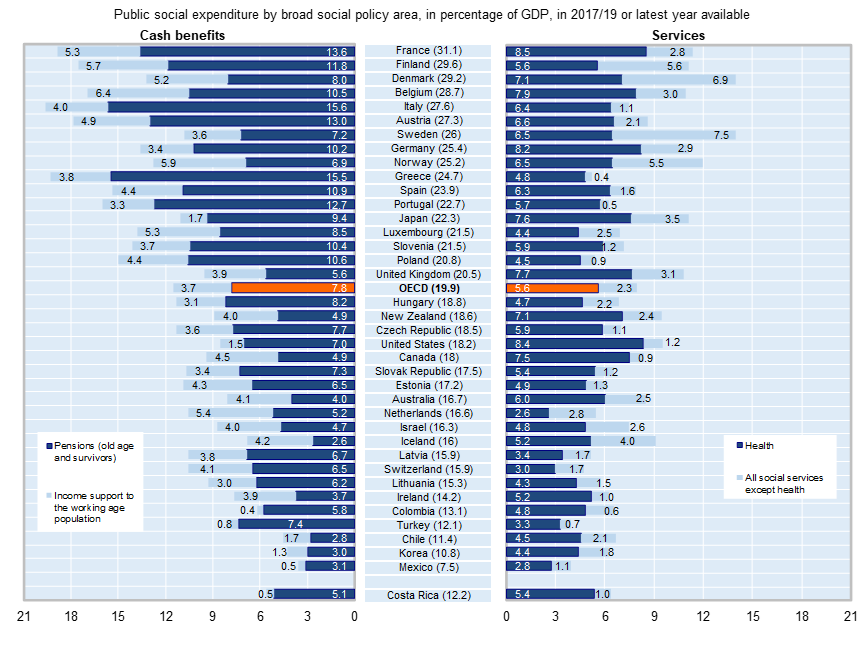
OECD Social Expenditure Update, 2020
Means Tested Benefits
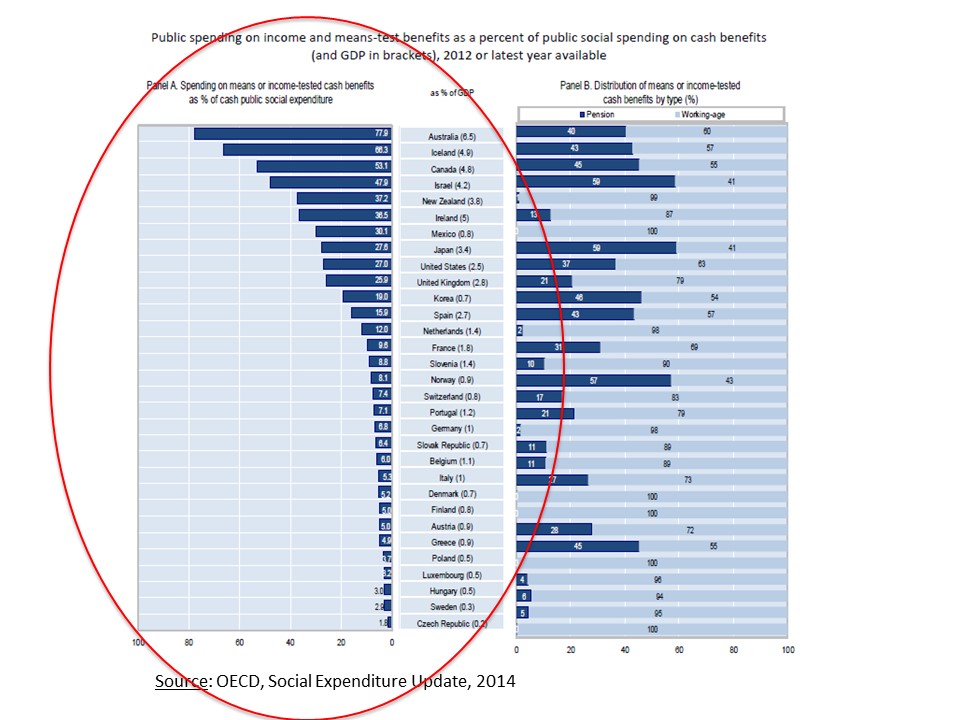
OECD Social Expenditure Update 2014
Pillars of Social Democracy
Swedish Prime Minister Stefan Löfven video
Three pillars of the Nordic model
- Full Employment
- Universal and Generous Welfare System
- Organized Labor Market
Think about
- How each pillar is important
- How they work together to support the system
Origins of Three Worlds of Welfare Capitalism
Where do the three worlds come from?
Esping-Andersen (pp. 146-148)
- Labor unions and left parties only part of the story
- Emphasizes “red-green coalitions”
- Other factors
- ethnicity
- religion
Gender and the Welfare State
Gender and the Three Worlds
LMEs (Anglo-American countries): free market approach
Corporatist (Germany, Austria, Italy, etc): traditional, male breadwinner approach (historically, but recently more like Scandinavia)
Nordic SMEs (Scandinavia): transform gender relations; dual wage-earner approach
Scandinavian Policies
- Universal public day care
- Altered workday for parents
- Increased parental leave
- Men equally entitled
- Norway example (46 weeks)
- Men and women both get 15 weeks after birth of child
- Women get 3 weeks before birth
- Then they can divide up an additional 16 weeks between them
- Can stretch total out to 56 weeks at 80% pay
- Rationale: equality depends on changing men
Discussion
Explore various categories with a neighbor
How do spending patterns relate to “three worlds” concept?
What world would you prefer to live in?
Social Spending in OECD
OECD Social Expenditure Update, 2020